The case for outdoor movement is not principally a case against indoor training. It is, more precisely, a case for attending to what is qualitatively different about the body's relationship with open, uncontrolled, variable space — the kind of difference that does not register in a training log but accumulates meaningfully across a year of consistent practice.
What Open Space Changes
A gym presents the body with a controlled environment: fixed temperature, predictable surfaces, mirrors for form feedback, equipment calibrated to isolate specific movement patterns. This is genuinely useful. It is also, by design, a simplification of the conditions under which the body actually operates across a life.
Outdoor movement — running on variable terrain, carrying load across uneven ground, completing a session in a public park rather than a private studio — introduces inputs that indoor training systematically removes. Wind resistance is a genuine variable. Gradients are unscripted. Grip changes with weather. The proprioceptive demands of an uneven path are different from a treadmill belt, in ways that translate to functional capacity in ordinary life.
This is not a performance argument. It is a range-of-movement argument: the body adapted primarily to controlled surfaces has a narrower range of automatic responses than one that has regularly navigated variety. The training argument and the broader physical-intelligence argument point in the same direction — toward regular, deliberate time in open space.
Strength Work Beyond the Gym
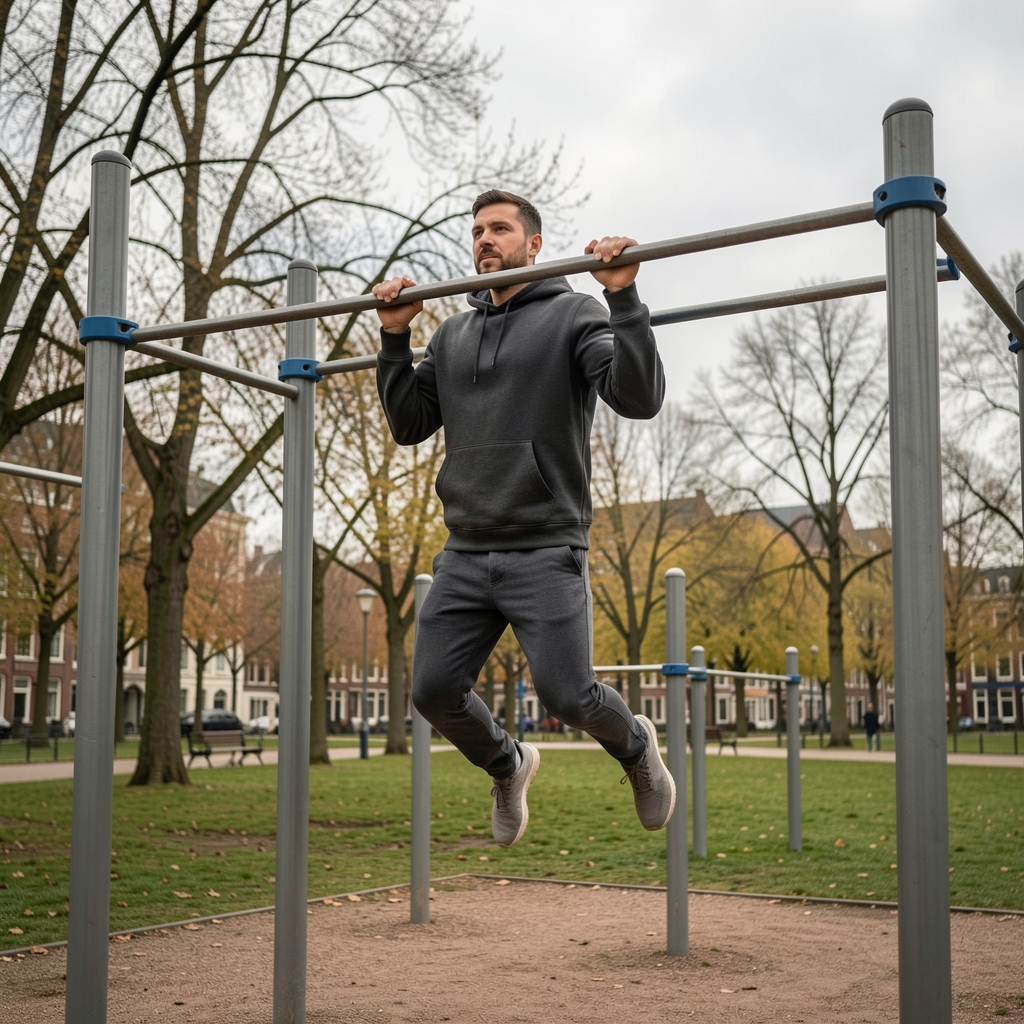
There is a tendency to categorise strength training as inherently indoor — dependent on iron, pulleys, and racks. That categorisation is a convenience rather than a functional truth. Calisthenics, the practice of using bodyweight as resistance across a wide range of movement patterns, is one of the oldest strength practices and one that requires no equipment, no membership, and no fixed location.
A park bench, a low wall, or a set of parallel bars in a public fitness installation offers the basic equipment for a complete upper-body session. Pull patterns, push patterns, core stability, and explosive movements can all be executed in open space using the body's own mass. The limiting factor is knowledge of progressive programming — knowing how to increase load and complexity without access to plates.
The progression logic is different from barbell work but equally structured. A push-up becomes an archer push-up, then a one-arm push-up with assistance, then a full single-arm press. A hanging pull-up becomes a slow-negative, then a weighted variation using a loaded backpack. The path is long, technically interesting, and — for those who pursue it — produces a quality of relative strength that transfers broadly.
"The body adapted primarily to controlled surfaces has a narrower range of automatic responses than one that has regularly navigated variety."
Running as a Practice, Not a Metric
The runner who defines their practice by pace and distance has made a category error — they have turned a physical practice into a data-collection exercise. Pace and distance matter for specific performance goals. For the broader practice of outdoor running as a component of men's daily habits, what matters more is consistency, enjoyment, and the capacity to sustain effort over months without accumulating the psychological weight of perpetual self-assessment.
The most consistent runners observed across long-form wellness journalism are those who run because they like how it feels — who have found routes that interest them, times of day that fit their circadian rhythm, and a pace that allows sustained internal observation rather than sustained laboured breathing. They tend not to use music; they attend to the environment. They tend not to time themselves obsessively; they run until the session feels complete.
This is not an argument against tracking. It is an argument for developing a relationship with outdoor movement that does not depend on tracking in order to feel meaningful. The runners who sustain twenty years of consistent practice without injury are not the ones who spent those years chasing personal records — they are the ones who learned to find the run itself sufficient.
The Weekend Adventure Habit
The weekend adventure — a category of outdoor activity that sits between recreational movement and deliberate physical challenge — is an underexplored dimension of men's active lifestyle writing. Not the organised event, not the booked excursion, but the self-directed decision to use a Saturday morning for something that takes the body into unfamiliar territory.
In practical terms: a long-distance walk in a direction not previously taken. A cycling route into countryside that requires navigation. A sea swim, a river crossing, an early ascent of a hill close enough to reach without significant logistics. These are activities that produce, in the body, a kind of engagement that ordinary working-week fitness routines do not — a heightened attentiveness to environment, a physical problem-solving that is different from the linear logic of gym-based training.
The work-life rhythm that includes a regular weekend physical excursion tends to produce better recovery from working-week stress than the one that reserves weekends for passive rest. The body offered genuine physical engagement in novel environments appears to return to the working week with more energy, not less — a counterintuitive finding that has been observed consistently enough in wellness research to merit editorial attention.
Active Recovery and Its Outdoor Logic
Active recovery — the practice of low-intensity movement on rest days from structured training — has a natural outdoor form in the extended walk. Walking at a pace that does not elevate breathing significantly, sustained for forty-five minutes to an hour, promotes circulation and supports the conditions for muscular repair without adding the training load that would compromise recovery.
The distinction between a productive walk and an aimless one lies in the conditions of attention. A walk taken with a specific destination or observation — a particular park, a route that includes a noteworthy building, a canal path that changes with the season — is a walk that sustains engagement for an hour. A walk taken without purpose tends to contract to fifteen minutes.
Flexibility work in open space — the kind of deliberate stretching and mobility practice that belongs on rest days — benefits from natural light and variable ground in ways that are difficult to replicate indoors. A session of hip-opening and thoracic rotation conducted in a park, on grass, has a different quality from the same movements performed on a gym floor — less formal, more embodied.
- 01 Two to three outdoor sessions per week, in addition to gym-based training, produces a qualitatively different range of movement adaptation.
- 02 Bodyweight strength training on outdoor furniture is a viable primary training modality, not a substitute for unavailable equipment.
- 03 Running pace-independence — running until the session feels complete, without a fixed distance target — sustains the practice across longer periods.
- 04 A single weekly outdoor adventure — a long walk, a cycle into new terrain — produces recovery benefits that passive weekend rest does not.
- 05 Active recovery walks are more sustained when they have a destination or observation point — purpose governs duration.
Body Composition and Outdoor Work
The role of outdoor movement in body composition is often framed in terms of caloric expenditure — a framing that misses the more interesting dimension. The question is not whether running burns more energy per minute than a treadmill walk (it does, marginally) but whether outdoor movement, sustained over a year, produces a different relationship with physical activity that indirectly supports the body composition goals most men hold.
The answer, broadly observed: it does. The outdoor practice tends to be more voluntary, more intrinsically motivated, and less susceptible to the motivational fluctuations that cause gym attendance to drop in the third month of a membership. The outdoor practitioner — the man who runs because he finds the morning run genuinely pleasant — accumulates more training volume across a year than the gym member driven primarily by aesthetic aspiration.
That volume difference, compounded across seasons, produces body composition outcomes that no single training programme, however optimised, can match. The best programme is the one sustained. The most sustainable programme is the one that contains intrinsic pleasure. Outdoor movement, for many men, is where that pleasure lives.